


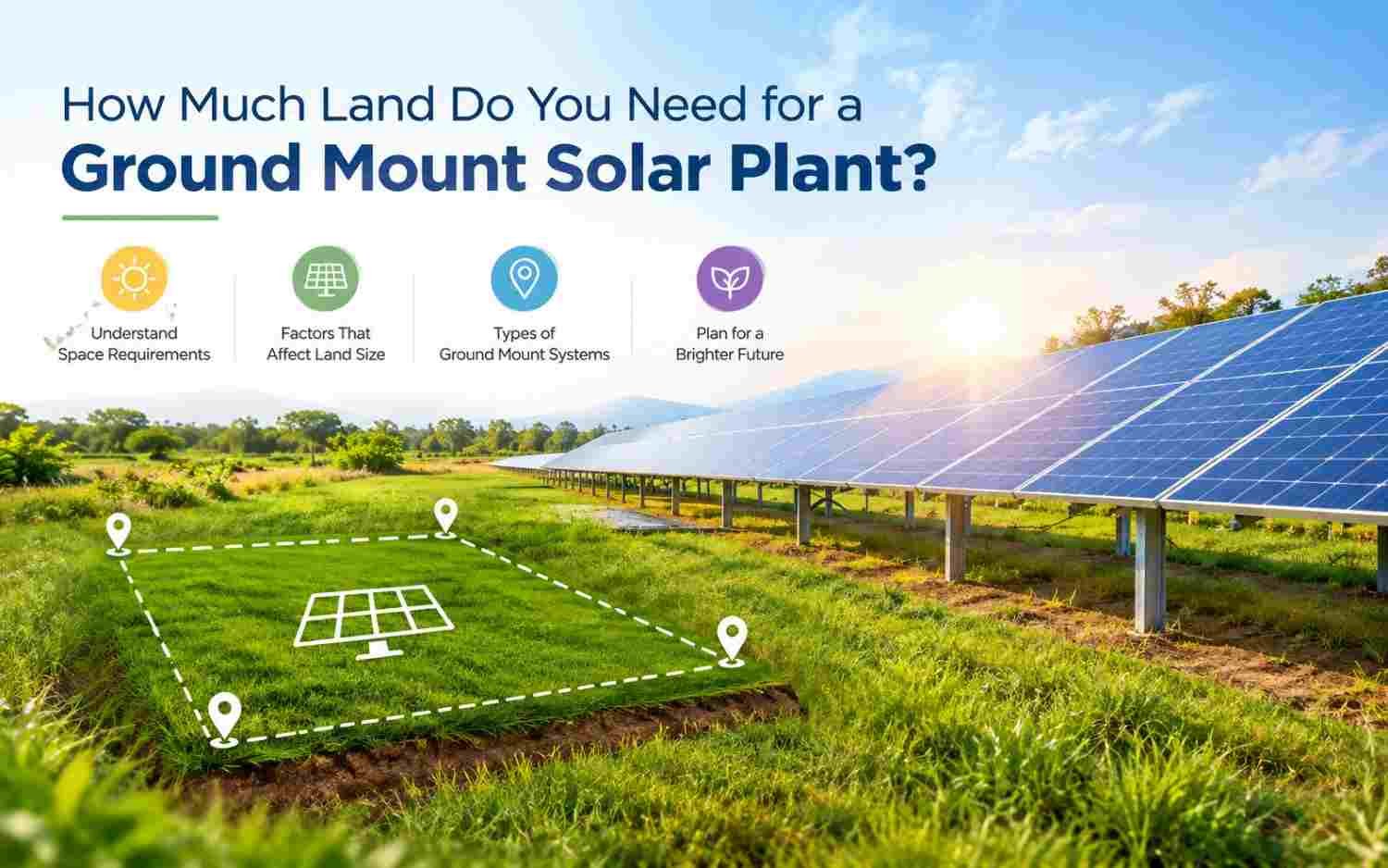
How Much Land Do You Need for a Ground Mount Solar Plant?
Installing a solar power plant on open land can be an effective way to generate renewable electricity at a larger scale. However, one of the first questions businesses, industries, institutions, and landowners often have is: how much land is required for ground mount solar plant installation? The answer depends on several factors, including the plant capacity, solar panel technology, mounting arrangement, site conditions, access roads, equipment areas, and spacing between panel rows.
Understanding the ground mount solar plant land requirement before beginning a project helps with proper planning, budgeting, and site selection. Whether you are considering a small commercial installation or a large utility-scale project, evaluating available land is an important part of solar project planning.
What Determines the Land Required for a Ground Mount Solar Plant?
The land required for ground mount solar plant installation is not determined only by the number of solar panels. A complete solar project requires sufficient space for panels as well as mounting structures, inverter areas, transformers, cables, maintenance access, internal pathways, and other essential infrastructure.
The overall solar plant space requirement can therefore vary from one project to another. A site with a better layout and fewer obstacles may accommodate more panels efficiently than a similarly sized plot with irregular boundaries or shading issues.
Some important factors affecting land requirements include:
Planned solar plant capacity
Solar panel wattage and dimensions
Panel orientation and tilt angle
Distance between panel rows
Type of mounting structure
Land shape and slope
Internal roads and maintenance pathways
Electrical equipment and inverter areas
Shading and shadow considerations
Future maintenance requirements
How Much Land Is Needed for Different Solar Plant Capacities?
The amount of land needed for solar power plant projects generally increases as the system capacity increases. However, there is no single land-to-capacity ratio applicable to every project because panel efficiency, technology, layout, and site conditions can affect the final design.
For instance, an initial solar project might need just a moderate-sized piece of land, while a multi-megawatt system would need much more land space. It is, therefore, prudent to conduct an assessment of the site before undertaking any project because the land needed is not dependent on capacity alone.
For anyone specifically researching land required for 1 MW solar plant, the actual requirement should be calculated according to the selected modules, mounting system, site geometry, row spacing, and supporting infrastructure.
Why Panel Spacing Matters in a Ground Mount Solar Plant
Panel spacing is an important part of determining the ground mount solar plant land requirement. Solar panels must be positioned carefully to reduce unwanted shading between rows and allow sufficient access for cleaning, inspection, repairs, and maintenance.
If panels are installed too close together, one row can cast shadows on another, potentially affecting energy generation. On the other hand, excessive spacing can increase the total land requirement unnecessarily.
An effective site plan should be a combination of energy generation, accessibility, land use, and maintenance. Effective site planning becomes crucial during the selection of land needed for ground-mounted solar plants.
What Other Space Is Required Besides Solar Panels?
A common mistake is to calculate land requirements based only on the physical area occupied by solar modules. A ground-mounted project also needs space for several supporting elements.
These may include:
Inverters and Electrical Equipment
Inverters, transformers, electrical panels, and related equipment need designated areas that are accessible for inspection and servicing.
Internal Access Paths
Maintenance teams need access throughout the solar field. Proper pathways make cleaning, inspections, troubleshooting, and component replacement easier.
Mounting Structures
The selected mounting structure determines how panels are arranged and how efficiently available land can be utilized.
Boundary and Safety Areas
Depending on the project, suitable perimeter space may be required for fencing, security, drainage, and safe operation.
How to Calculate the Land Requirement for Your Project
A basic land assessment begins with the proposed plant capacity and the type of solar modules being considered. The number of panels can then be estimated based on their individual capacity.
After determining the approximate panel quantity, the layout must account for panel dimensions, tilt, row-to-row spacing, access pathways, electrical equipment, and site-specific constraints.
For this reason, an assessment of the spatial requirements for the solar power plant should be made at the design stage before the purchase or rental of any land. It is only through a professional site survey that the various constraints of the site could be found out.
Choosing the Right Land for Ground Mount Solar Installation
It is recommended that there be enough solar exposure, accessibility, and sufficient land area for the planned system to be constructed. Shaded areas caused by structures or trees are something that needs to be accounted for.
Land shape is also important. A rectangular or reasonably regular plot can often be easier to design than a highly irregular site. Drainage, soil conditions, road access, and proximity to electrical infrastructure can also influence project planning.
In case businesses are looking into installing ground-mounted solar panels professionally, it is possible to conduct a feasibility study that will determine if the site has enough capacity to host the panels.
Plan Your Ground Mount Solar Project with the Right Approach
Determining the land required for ground mount solar plant installation is an important step before finalizing a solar project. Instead of relying on a general acreage estimate, the calculation should consider panel technology, capacity, mounting design, row spacing, site conditions, infrastructure, and future maintenance access.
If you are also exploring other solar solutions, you can learn more about Solar Panel Installation in Delhi and Ground Mount Solar Installation in Delhi as part of your renewable energy planning.
Seeon Green Energy Pvt. Ltd. can help businesses and property owners understand site requirements and plan solar installations according to their available space and energy objectives. With proper site assessment and system design, available land can be utilized more efficiently while creating a practical foundation for long-term solar power generation.