


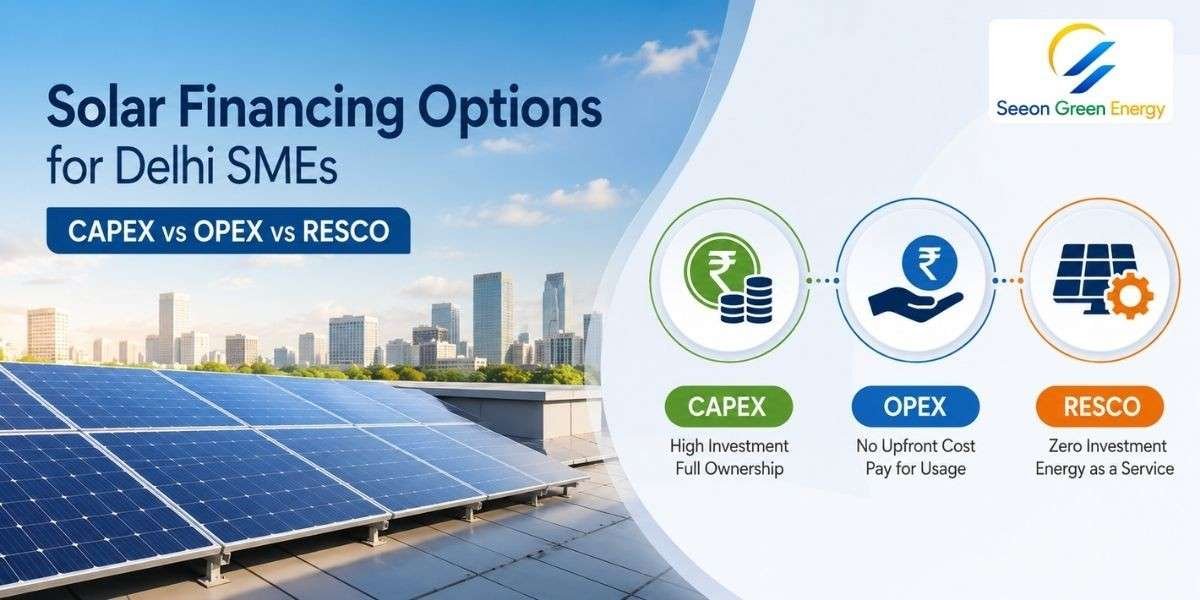
Solar Financing Options for Delhi SMEs: CAPEX vs OPEX vs RESCO
For many small and medium enterprises (SMEs) in Delhi, managing electricity expenses has become an important part of business planning. Energy costs directly affect monthly budgets, and businesses are now looking for smarter ways to reduce dependency on conventional power sources. This is where solar energy is gaining attention as a practical and sustainable option. Companies planning Solar Rooftop Installation in Delhi often face one major question: Should they invest in their own solar system or choose a financing model that reduces the upfront burden?
The good news is that businesses today have multiple options. Solar financing options for SMEs allow companies to select a model based on their financial capacity, energy requirements, and long-term goals. The three commonly discussed models are CAPEX, OPEX, and RESCO. Each option has different ownership structures, investment requirements, and benefits.
At Seeon Green Energy Pvt. Ltd., businesses can explore professional guidance to understand which solar model matches their requirements and how they can move towards cleaner energy with better financial planning.
Why Are Delhi SMEs Moving Towards Solar Energy?
Before choosing a financing model, businesses need to understand why solar adoption is becoming popular among SMEs. Electricity is one of the regular operating expenses for industries, offices, warehouses, and commercial establishments. Reducing these expenses can help businesses improve financial stability.
Solar power allows businesses to generate electricity using rooftop solar systems installed with photovoltaic (PV) technology. Instead of depending completely on grid electricity, companies can use renewable energy to support their daily operations.
For SMEs, solar is not only an environmental decision; it can also become a strategic business decision. With proper planning, solar adoption can support energy management, sustainability goals, and long-term cost planning.
Many businesses now look for commercial solar solutions because they want reliable energy options without affecting their core operations. The right financing model helps them adopt solar according to their business situation.
Understanding Solar Financing Options for SMEs
Every business has different financial priorities. Some companies prefer owning assets, while others want to avoid large upfront investments. This is why understanding different solar financing models becomes important.
The choice between CAPEX, OPEX, and RESCO depends on factors such as available capital, ownership preference, maintenance responsibility, and future business plans.
Let’s understand these models in detail.
CAPEX Solar Model: Investing in Complete Solar Ownership
CAPEX stands for Capital Expenditure. In this model, the business purchases and owns the complete solar system. The company invests in solar panels, installation, equipment, and other project requirements.
Once the system is installed, the business becomes the owner of the solar asset and can use the electricity generated by the system.
Benefits of the CAPEX Model
The biggest advantage of CAPEX is ownership. Businesses that choose this model have complete control over their solar system.
Key benefits include:
Full ownership of the solar installation
Greater control over energy generation
Potential long-term financial benefits
Increased independence from rising electricity costs
CAPEX is often suitable for businesses that have available funds and want to treat solar as a long-term solar power investment.
However, businesses should carefully evaluate factors like solar installation cost, available rooftop space, electricity consumption, and maintenance requirements before making a decision.
OPEX Solar Model: Reducing Upfront Investment Pressure
OPEX stands for Operational Expenditure. Unlike CAPEX, businesses do not purchase the solar system directly in this model.
Instead, a third-party company usually invests in, installs, and manages the solar project. The business pays for the electricity generated from the system based on agreed terms.
This model provides financial flexibility because companies can access solar energy without making a large initial investment.
Benefits of the OPEX Model
The OPEX approach can be useful for SMEs that want to focus their capital on business expansion while still benefiting from solar power.
Advantages include:
Lower upfront financial requirement
Reduced maintenance responsibility
Easier adoption of solar energy
Better management of operational expenses
For many growing businesses, OPEX works as a cost-effective energy solution because it allows them to reduce electricity costs without purchasing the complete system.
RESCO Solar Model: Using Solar Through a Service Provider
RESCO stands for Renewable Energy Service Company. This model works similarly to OPEX, where a third party develops and manages the solar project.
Under a RESCO agreement, a solar developer installs and maintains the system, while the business pays for the electricity it consumes. Many RESCO projects operate through a Power Purchase Agreement (PPA).
This approach allows businesses to use solar energy without taking direct ownership of the equipment.
Benefits of the RESCO Model
RESCO can be a suitable choice for SMEs that want a simple transition towards renewable energy.
Benefits include:
Minimal upfront investment
Professional project management
Reduced technical responsibility
Access to clean energy solutions
Businesses looking for rooftop solar financing often consider RESCO because it provides a structured way to adopt solar without managing the entire project themselves.
CAPEX vs OPEX vs RESCO: Which Solar Model Is Right for SMEs?
There is no universal answer because every business has different requirements. The best choice depends on financial goals, energy consumption, and long-term planning.
A company with available capital may prefer CAPEX because it provides ownership benefits. On the other hand, SMEs that want predictable expenses and less responsibility may find OPEX or RESCO more suitable.
Factors SMEs Should Consider Before Choosing Solar Financing
Selecting a solar financing model requires careful evaluation. Businesses should avoid choosing an option only because it looks cheaper initially.
Here are some important factors to consider:
Business Financial Goals
A company should understand whether it wants asset ownership or prefers keeping capital available for other business activities.
Electricity Consumption Pattern
The size of the solar system depends on electricity usage. Understanding current consumption helps create a more practical solar plan.
Rooftop Availability
The condition, size, and suitability of the rooftop affect the design of solar projects.
Long-Term Planning
Businesses should consider their future expansion plans before selecting a financing model. A well-planned solar decision can support a company’s growth journey.
How Solar Companies Help SMEs Make Better Decisions
Solar projects involve technical planning, financial evaluation, and installation management. Working with experienced professionals helps businesses understand available options clearly.
Reliable Solar Companies in Delhi NCR can guide SMEs through system selection, project planning, installation, and financing discussions.
Seeon Green Energy Pvt. Ltd. helps businesses evaluate solar solutions based on their requirements. With professional support, companies can better understand available financing options and choose a model that aligns with their operational goals.
A transparent approach helps businesses avoid confusion and make a more informed solar investment decision.
Understanding Solar Savings and Project Costs
Many businesses are interested in solar because of the potential for solar energy savings. However, the actual benefits depend on several factors.
Solar project costs can vary based on:
System size
Solar panel quality
Installation requirements
Rooftop conditions
Energy consumption
Instead of focusing only on initial cost, businesses should look at the overall value of the project, including long-term benefits, energy management, and sustainability advantages.
Professional planning helps companies understand realistic expectations from their solar investment.
The Future of Solar Adoption Among Delhi SMEs
The shift towards renewable energy is becoming an important part of modern business planning. As companies focus on sustainability and efficient operations, solar power continues to create new opportunities.
For SMEs, solar adoption can support better energy management while contributing to a cleaner environment. Different financing models make it easier for businesses with different budgets to participate in the renewable energy transition.
Whether a company chooses CAPEX, OPEX, or RESCO, the key is selecting a model that supports its financial and operational goals.
Conclusion: Choosing the Right Solar Financing Model for Your Business
Choosing between CAPEX, OPEX, and RESCO depends on your business needs, investment capacity, and future objectives. CAPEX provides ownership, while OPEX and RESCO offer flexibility with lower upfront commitments.
A carefully planned solar project can become a valuable business asset by supporting cleaner energy usage and better cost management.
If you are planning a solar rooftop installation and want expert guidance on the right financing option, connect with Seeon Green Energy Pvt. Ltd. Our team can help you understand suitable solar solutions based on your business requirements and goals.