


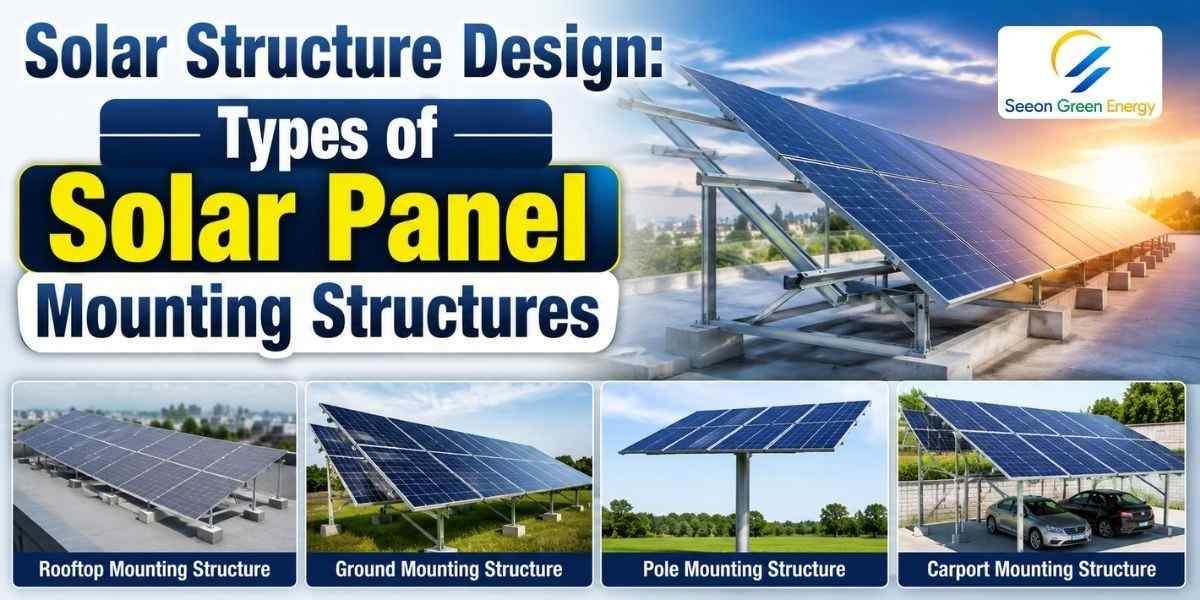
Solar Structure Design: Types of Solar Panel Mounting Structures
A solar power system is only as strong and reliable as the framework supporting its panels. For homeowners, businesses, and project developers working with Solar Companies in Delhi NCR, understanding the basics of solar structure design can make a real difference when selecting a system. A properly designed structure keeps the photovoltaic module secure, maintains the required orientation, and helps the system handle environmental conditions over its operating life.
A solar panel structure is more than a metal frame placed beneath a panel. It forms an important part of the complete photovoltaic system by connecting the modules to a roof, ground foundation, or another supporting surface. The right solar structure design considers the site, panel arrangement, loads, material selection, maintenance requirements, and installation method.
Whether the project involves a home rooftop, factory, commercial building, or solar power plant, the mounting system deserves careful attention. After all, even the best solar panel cannot produce electricity while taking an unexpected trip off the roof.
What Is a Solar Panel Structure?
A solar panel structure is the mechanical framework used to support and secure photovoltaic modules. It connects the panels to the building roof, ground, shed, carport, or another suitable foundation.
The structure normally includes components such as mounting rails, clamps, brackets, supports, fasteners, and foundations or roof attachments, depending on the application. Together, these solar mounting components create a stable PV support structure for the array.
According to the U.S. Department of Energy, PV arrays need a stable and durable structure capable of supporting the array while withstanding conditions such as wind, rain, hail, and corrosion. The mounting arrangement also helps position the array appropriately for solar exposure.
This makes the mounting system an essential part of the overall solar installation framework rather than a simple accessory.
Why Does Solar Structure Design Matter?
Good solar structure design balances energy performance, structural stability, safety, installation practicality, and long-term durability.
The design needs to suit the actual site rather than follow a one-size-fits-all approach. A rooftop system, for example, has different structural requirements from a ground-mounted solar farm. Similarly, a metal shed may require a different attachment method from an RCC roof.
Several factors influence the final design:
Roof or ground conditions
Panel dimensions and weight
Wind loads
Installation location
Panel orientation and tilt
Foundation requirements
Material and corrosion resistance
Maintenance access
Future system expansion
In India, wind loading is an important structural consideration. BIS identifies IS 875 (Part 3): 2015 as the Indian Standard covering wind loads for buildings and structures. A qualified structural designer should determine the applicable loads and design requirements for the specific project.
For PV array design, IEC 62548-1 also covers design requirements and includes provisions related to mounting structures and safety.
Types of Solar Panel Mounting Structures
Different project conditions require different mounting approaches. The most common categories include rooftop systems, ground-mounted systems, carports, shed-mounted systems, and tracking structures.
1. Rooftop Solar Mounting Structure
Rooftop PV mounting systems are widely used where the building roof provides suitable space for solar installation. Depending on the roof, the structure can use different mounting and attachment arrangements.
Rooftop systems can work particularly well for homes, offices, commercial buildings, factories, and warehouses because they make productive use of existing space.
The design should consider:
Roof type and condition
Available installation area
Shading
Panel orientation
Tilt requirements
Attachment or ballast method
Access for maintenance
The structure should not simply fit as many modules as possible onto the roof. The layout also needs to allow secure panel support, appropriate spacing, safe access, and practical maintenance.
For a professional installation, the roof itself should be assessed before selecting the mounting arrangement.
2. Ground Mount Solar System
A ground mount solar system places the PV array on a dedicated ground-supported framework rather than directly on a building.
Ground-mounted systems are common in larger commercial, community, and utility-scale applications. The U.S. Department of Energy notes that ground-mounted systems can use fixed-tilt arrangements or tracking systems depending on the application.
Ground mounting can provide greater flexibility in array positioning because the designer does not have to work around an existing roof. However, the foundation, soil conditions, site layout, drainage, cable routing, access, and environmental loads all become important design considerations.
For larger installations, the structure becomes part of broader renewable energy infrastructure. IEC TS 62738 provides design guidelines and recommendations specifically for ground-mounted photovoltaic power plants.
3. Solar Carport Structure
A solar carport combines parking infrastructure with solar generation. The PV modules sit above the parking area, providing shade while using otherwise underutilized space for electricity generation.
The structural design needs to account for the height and geometry of the carport, vehicle clearance, foundations, wind loads, drainage, electrical routing, and maintenance access.
Solar carports can also be planned alongside EV charging infrastructure where the site and electrical design support it. The key point is simple: the structure has to work as both a parking facility and a solar array support system.
4. Shed-Mounted Solar Structure
Industrial buildings and warehouses often have metal sheet roofs or other shed-style roofing. A suitable solar panel racking arrangement can allow these surfaces to support a PV system without consuming additional ground space.
However, the roof and attachment method need careful evaluation. The mounting system should work with the roof profile and structural capacity rather than forcing an unsuitable solution onto the building.
Heat management, spacing, waterproofing, corrosion resistance, and maintenance access should also form part of the design discussion.
5. Solar Tracker Structure
A solar tracker changes the position of PV modules during operation to follow the sun. Tracking systems therefore require moving mechanical components and a more complex structural arrangement than fixed-tilt systems.
The U.S. Department of Energy notes that ground-mounted PV systems may use tracking mechanisms to follow the sun. It also identifies fixed-tilt and one-axis tracking as important categories for ground-mounted applications.
Trackers can improve solar exposure in appropriate applications, but they also introduce additional mechanical complexity. The decision should therefore consider the project objective, available space, maintenance capability, cost, and expected performance rather than assuming that tracking is automatically better.
Key Components of a Solar Mounting Structure
A typical solar panel mounting structure consists of several components that work together to keep the modules secure.
Mounting Rails: Solar mounting rails provide a supporting surface for the modules and clamps. Their dimensions and configuration depend on the module arrangement and structural design.
Module Clamps: Mid clamps and end clamps hold the photovoltaic modules against the mounting rails. Correct positioning and fastening are important for secure panel support.
Brackets and Supports: Brackets connect the mounting system to the roof or supporting framework. Ground-mounted systems may use posts, beams, foundations, or other structural members.
Fasteners and Connections: Bolts, nuts, washers, and other connection components join the structural members. Material compatibility matters because unsuitable combinations can contribute to corrosion over time.
Foundation or Roof Attachment: Ground systems need an appropriate foundation solution, while rooftop systems require an attachment or ballast strategy suitable for the roof.
The exact configuration varies by project. Good design focuses on compatibility between the module, mounting components, supporting surface, and environmental conditions.
Factors That Affect Solar Structure Design
A reliable structure starts with the site, not the catalogue.
Wind and Environmental Loads
Wind can place significant forces on exposed solar modules and their supporting structures. In India, designers should consider the applicable requirements of relevant Indian Standards, including IS 875 for wind loading.
Rain, corrosion, temperature, and other environmental conditions also influence material selection and long-term durability.
Panel Orientation and Tilt
The mounting system determines how the modules are positioned. Orientation and tilt influence solar exposure and therefore form an important part of PV system planning.
The U.S. Department of Energy explains that fixed PV arrays are positioned according to factors such as local latitude, orientation, and system requirements.
There is no universal angle that works perfectly for every project. A professional design should consider location, roof geometry, energy objectives, shading, and the module layout.
Roof or Soil Conditions
Rooftop systems must work with the building's existing structure. Ground systems require attention to soil and foundation conditions.
Ignoring the supporting surface can compromise structural stability, even when the mounting components themselves are well manufactured.
Material Selection
Common structural materials include aluminium and steel, with the choice depending on the project design and environmental conditions.
Corrosion resistance is particularly important because solar mounting systems remain exposed for long periods. Material selection should therefore support reliable performance and long-term durability.
Maintenance and Accessibility
A solar structure should allow reasonable access for inspection, cleaning, electrical work, and component replacement.
A design that looks perfect on paper but leaves no practical maintenance access is not a particularly clever design. Solar systems are built to operate for years, so maintenance should be considered from the beginning.
How to Choose the Right Solar Panel Mounting Structure
The right solar panel mounting structure depends on the project rather than simply the panel capacity.
Start by evaluating the installation location. Is the system going on an RCC roof, metal shed, open land, parking area, or another structure?
Next, assess the physical and environmental conditions. The design should account for wind exposure, structural capacity, shading, orientation, foundation requirements, and corrosion conditions.
Then consider installation and maintenance. A cost-effective solution is not necessarily the system with the lowest initial price. A better approach is to evaluate structural quality, installation requirements, durability, accessibility, and expected operating needs together.
For customers comparing Solar Panel Manufacturers in Delhi, it is equally important to look beyond the panel itself. A photovoltaic system includes modules, mounting structures, electrical equipment such as the solar inverter, and other balance-of-system components. The Department of Energy also describes mounting structures as one of the essential parts of a complete PV system.
This is where an experienced solar EPC or professional solar provider can help connect the equipment selection with actual site requirements.
Solar Structure Design and Quality Standards
Quality should be considered at both the structural and system level.
IEC 62548-1 establishes design requirements for PV arrays, including electrical safety provisions and revised requirements related to mounting structures.
For Indian projects, applicable BIS standards and project-specific engineering requirements should also be considered. BIS identifies IS 875 Part 3 as the current third revision covering wind loads.
Module selection can involve additional regulatory requirements. MNRE maintains the Approved List of Models and Manufacturers (ALMM), and its current guidance specifies circumstances in which listed PV module models and manufacturers are required for certain government, government-assisted, open-access, and net-metering projects.
This distinction matters: compliance requirements can apply differently to modules, electrical equipment, structures, and the overall project. A professional team should check the requirements applicable to the specific installation instead of treating every solar project the same.
Why Professional Solar Structure Design Is Worth It
A properly engineered structure provides more than a place to attach panels. It supports structural stability, secure module positioning, efficient installation, weather resistance, and long-term system reliability.
For businesses exploring Solar Companies, professional planning can also make it easier to compare rooftop, ground-mounted, shed, and carport options based on actual site conditions.
Seeon Green Energy Pvt. Ltd. presents its solar services around project-specific planning, component selection, installation, and long-term performance. Its published information also highlights work across residential, commercial, and industrial applications.
For customers researching solar panel manufacturers, this broader approach is useful because the quality of a solar installation depends on more than the photovoltaic module alone.
A good solar project brings together the module, mounting structure, electrical design, installation process, and site conditions into one working system.
Conclusion: Choosing the Right Solar Structure Design
The purpose of a solar structure is simple: to support the photovoltaic array safely and position it correctly. A well-designed structure considers wind loads, supporting surfaces, panel orientation, materials, corrosion resistance, and maintenance requirements.
From rooftop PV mounting and ground mount solar systems to solar carports and tracking structures, each application has different requirements. A reliable solar panel mounting structure provides secure support and helps the system perform reliably over time.
Looking for a suitable solar structure for your project? Contact Seeon Green Energy Pvt. Ltd. today to discuss your requirements and find the right mounting solution.
Frequently Asked Questions About Solar Panel Mounting Structures
What Is A Solar Panel Mounting Structure?
A solar panel mounting structure is the mechanical framework that supports photovoltaic modules and secures them to a roof, ground foundation, shed, carport, or another suitable surface.
What Factors Are Important In Solar Structure Design?
Important factors include site conditions, wind loads, roof or soil conditions, panel dimensions, orientation, tilt, material selection, corrosion resistance, foundation or attachment methods, and maintenance access.
Which Is Better: Rooftop Or Ground-Mounted Solar?
Neither is universally better. The suitable option depends on available space, roof condition, shading, land availability, project size, structural requirements, and installation objectives.
Are Solar Trackers Suitable For Every Project?
No. Trackers add mechanical complexity and are more appropriate for applications where their additional movement and maintenance requirements make sense for the project's objectives.
What Should I Check Before Selecting A Solar Structure?
Check the structure's design suitability, load requirements, material quality, corrosion protection, installation method, compatibility with the selected photovoltaic modules, and the experience of the installation or engineering team.